
Best European Cloud Storage in 2026: 5 Providers Compared
We compared Proton Drive, Tresorit, pCloud, kDrive, and Internxt on encryption, pricing, and collaboration. Here's who should use what.
Verdict
There is no single winner here, only four clean answers. pCloud for a large archive you pay for once. Proton Drive for encrypted personal files inside a wider suite. Tresorit for regulated business sharing. kDrive for Swiss-hosted live document editing. Internxt is the fifth option worth testing before you commit.
Best for
- Choosing a European cloud provider for the first time
- Comparing encryption models rather than price per gigabyte
- Teams that need a documented hosting region
Avoid if
- You have already shortlisted two providers and want a head to head
- You need a Google Workspace replacement rather than storage
Sources and prices checked 16 September 2026
Check the current pCloud Lifetime priceSome links are affiliate links. Learn more

9 claims checked · 12 sources · Reviewed 16 September 2026
Pricing and provider attributes re-checked against the canonical pricing dataset (data/pricing/cloud-storage.json), with each price dated next to it. Proton, Internxt and Google One rows re-checked 7 October 2026 from a German connection; pCloud and Tresorit USD rows remain the 16 September capture. Encryption, hosting and ownership claims were checked against the vendor pages listed below. This is a source review, not a new hands-on benchmark.
- pcloud pricing (pcloud.com)
- pcloud encryption (pcloud.com)
- pcloud data regions (pcloud.com)
- proton drive pricing (proton.me)
- proton drive security (proton.me)
- tresorit pricing (tresorit.com)
- tresorit security (tresorit.com)
- tresorit data residency (tresorit.com)
- infomaniak kdrive pricing (infomaniak.com)
- infomaniak trust center (infomaniak.com)
- internxt pricing (internxt.com)
- internxt annual billing (help.internxt.com)
Quick answer: Choose pCloud for media storage with a one-time lifetime payment, Proton Drive for encrypted personal storage inside the Proton suite, Tresorit for business sharing and controls, or kDrive for Swiss-hosted document collaboration. Internxt offers another encrypted option. Check encryption scope, selected hosting region and the full billing commitment before choosing.
Answer five questions and the calculator will narrow the field for you:
How much storage do you need?
Providers without a plan this large in your currency are dropped.
Editorial corrections checked on 6 September 2026 against the linked provider documentation, with every price drawn from our pricing dataset and dated next to it. This is a source review, not a new hands-on benchmark. Existing app screenshots are historical illustrations; prices below are dated observations, not guaranteed checkout offers. Some purchase links are affiliate links that support this site.
What does encryption actually protect?
Cloud storage privacy depends on who holds the decryption keys, where the provider and its infrastructure operate, and how your account is protected. Encryption at rest protects stored data but may leave the provider able to read it. End-to-end encryption encrypts content on your device, reducing the readable content held by the provider.
It does not make a service unbreachable. Account details, some metadata, shared-link settings and compromised endpoints can still expose information. A strong password, multifactor authentication, recovery methods and independent backups remain important with every provider.
The 2024 Dropbox Sign incident is a useful reminder to consider account data as well as document content. It is not evidence that every server-side-encrypted service exposes all files in a breach, or that an end-to-end-encrypted competitor would have escaped the same incident unharmed. See our Dropbox alternatives for options with different encryption models.
Does European hosting settle the jurisdiction question?
European headquarters and European storage can help meet procurement or data-location requirements, but neither proves blanket immunity from foreign legal demands. The US Department of Justice CLOUD Act explanation describes obligations in terms of jurisdiction and possession, custody or control of data, including data stored abroad.
Encryption can limit the readable content available to a provider. It does not prevent disclosure of information the provider can access. For organisational use, check the contract, subprocessors, region controls and relevant law. Swiss headquarters alone does not establish GDPR compliance for your use of a service.
How do the five providers compare?
| Product | File encryption | Headquarters | Representative plan | Best fit |
|---|---|---|---|---|
| pCloud | Server-side by default; Crypto folder costs extra on personal plans | Switzerland | 2 TB lifetime, US$499 (promo, was US$709, checked 16 Sep 2026) | Media libraries and upfront payment |
| Proton Drive | End-to-end encryption | Switzerland | Drive Plus 200 GB, €47.88 (list, checked 7 Oct 2026) | Personal encrypted storage and Proton bundle |
| Tresorit | End-to-end encryption | Switzerland | Personal Essential 1 TB, US$143.88 (list, checked 16 Sep 2026) | Controlled business sharing |
| Infomaniak kDrive | At rest and in transit; not E2EE by default | Switzerland | kDrive Solo 3 TB, €59.88 (list, checked 16 Sep 2026) | Collaborative documents |
| Internxt | Provider-described E2EE and post-quantum protection | Spain | Essential 1 TB, €119.88 (list, checked 7 Oct 2026) | Another encrypted storage option |
Currencies differ because the vendors price in different currencies; each figure links to the page it came from. Storage and editor requirements matter more than a single price-per-gigabyte score. Start with the cloud storage category, then test upload, download, sharing and recovery with non-sensitive files. To put five-year totals side by side, use the cloud storage cost calculator or read the underlying European cloud storage cost index.

Affiliate partnership — we may earn a commission at no cost to you.
Which provider fits your files and workflow?
Built in EU has affiliate partnerships with pCloud, Proton, Tresorit, Infomaniak and Internxt, so every provider below is one we can earn a commission from. That is why the section order follows the partnership and not a ranking. Each entry states the trade-off we would raise with a friend, and the comparison table above is ordered the same way.
pCloud
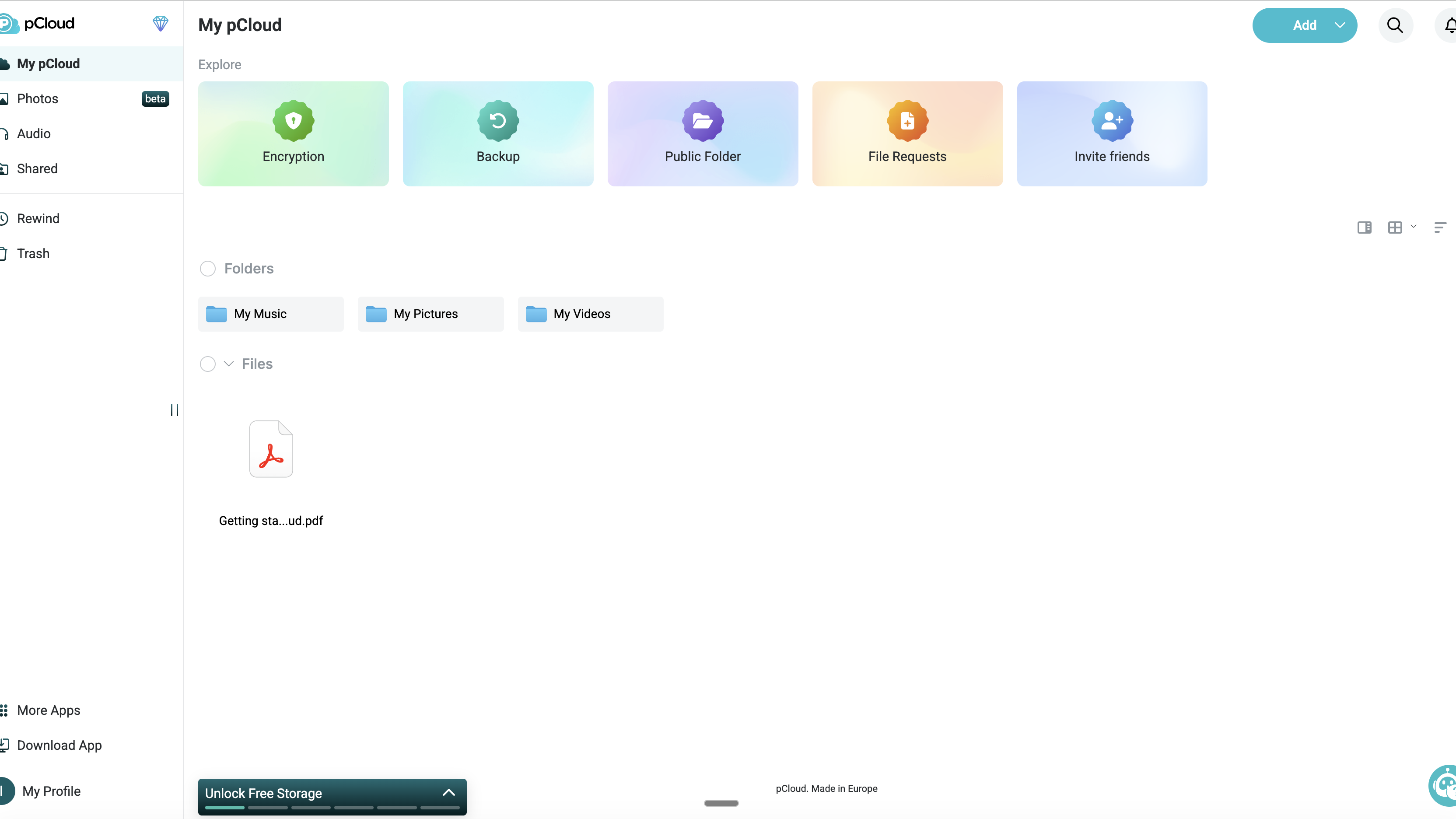
pCloud was founded in 2013 and is headquartered in Baar, Switzerland. It offers subscription and lifetime storage plans. “Lifetime” has a limit: the terms define it as the account owner's life or 99 years, whichever is shorter. Continued access also depends on the company continuing to operate.
Encryption and region: Personal plans use server-side encryption by default. Crypto adds client-side encryption for the separate Crypto folder; it does not automatically cover the rest of your account. Choose Luxembourg if you need European storage. pCloud also offers Dallas, US hosting. Its region documentation says a later move costs US$19.99 and loses existing Rewind history.
Pricing checked 16 September 2026: the official page displayed discounted lifetime prices in USD of US$219 (promo, was US$279, checked 16 Sep 2026) for 500 GB, US$499 (promo, was US$709, checked 16 Sep 2026) for 2 TB and US$1499 (promo, was US$2799, checked 16 Sep 2026) for 10 TB. These are promotional observations, not euro prices or guaranteed future offers. Crypto is extra: the encryption page listed pCloud Encryption at US$150 as a one-time purchase in the same capture.
Best for: Media libraries and long-term storage where upfront payment fits your budget. Trade-off: Compare the complete price including Crypto with an equivalent subscription in the same currency. Keep another backup; a lifetime purchase is not a guarantee of perpetual service. Our pCloud review explains the region, encryption and pricing trade-offs in more detail.
Proton Drive
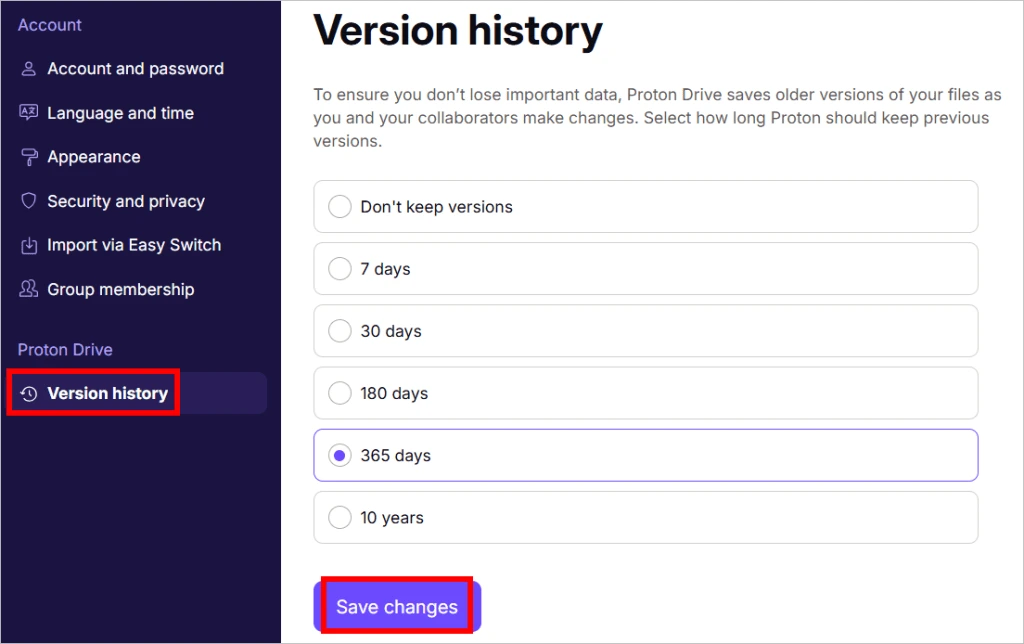
Source: Proton's version-history help.
Proton Drive suits people who want encrypted file storage alongside Proton Mail and Proton Pass. Proton AG is based in Geneva, Switzerland. Its primary shareholder is the nonprofit Proton Foundation, so describing it simply as employee-owned was inaccurate.
Encryption: File content is end-to-end encrypted before upload. This limits provider access to readable files; it does not remove account-security risks or imply all operational metadata is hidden.
Plans: the Drive pricing page showed Drive Plus covering 200 GB at €47.88 (list, checked 7 Oct 2026) on annual billing, or €4.99 (list, checked 7 Oct 2026) month to month. The wider bundles carry more storage: Proton Unlimited at €119.88 (list, checked 7 Oct 2026) and Proton Duo at €179.88 (list, checked 7 Oct 2026). Buy a bundle if you will use the other services, rather than assuming it is always the cheapest way to obtain storage.
Best for: Individuals who value encrypted storage and the integrated Proton services. Trade-off: Before moving a collaborative workspace, test the current document tools, shared permissions and file compatibility against your actual workflow. Proton's own page lists desktop apps for Windows and macOS plus a command-line client, so Linux desktop sync is the gap to check first.
Tresorit
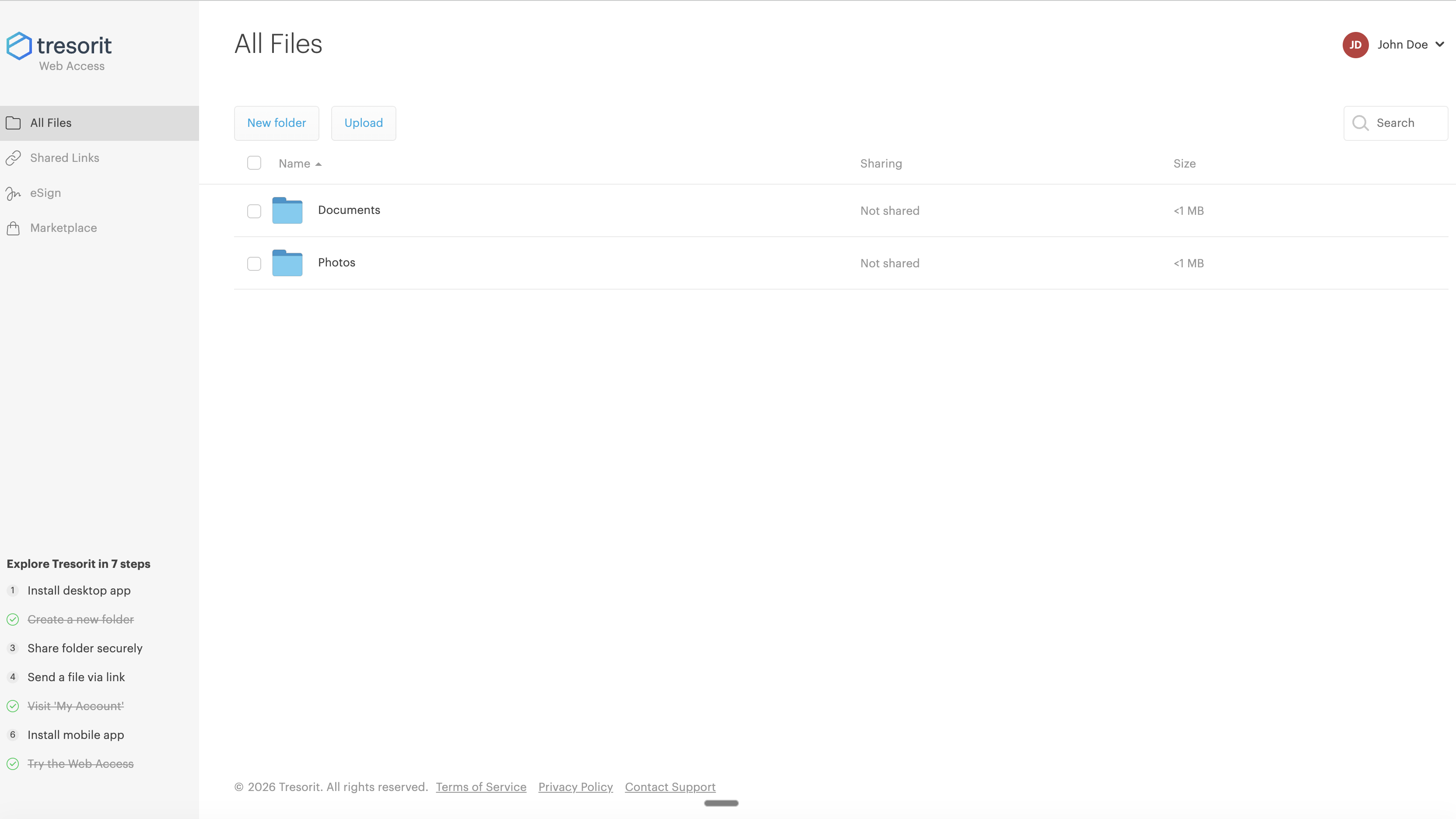
Tresorit is headquartered in Zurich, with an office in Budapest. Swiss Post acquired a majority stake in 2021. Ownership is relevant context, but does not prove a company's future incentives or security outcomes.
Encryption: Tresorit uses end-to-end encryption. Its security documentation describes AES-256 for file encryption and RSA-based key sharing. RSA-4096 is not categorically “stronger than AES-256”: they serve different cryptographic roles.
Plans and compliance: The personal pricing page lists Personal Lite at 50 GB for US$57 (list, checked 16 Sep 2026), Personal Essential at 1 TB for US$143.88 (list, checked 16 Sep 2026) and Personal Pro at 4 TB for US$329.88 (list, checked 16 Sep 2026). The page advertises a per-month equivalent rather than an annual total, so those totals are the monthly rate multiplied by twelve. Tresorit reports ISO 27001:2022 certification and offers business controls, data rooms and e-signatures across its products. HIPAA use requires a separate business associate agreement under its terms, not just a standard storage subscription. Accounts without a data-residency option are assigned to Ireland.
Best for: Organisations evaluating encrypted sharing, permissions and audit workflows. Trade-off: Confirm each required feature in the purchased plan and test document workflows. Certification does not automatically make your organisation compliant.
Infomaniak kDrive
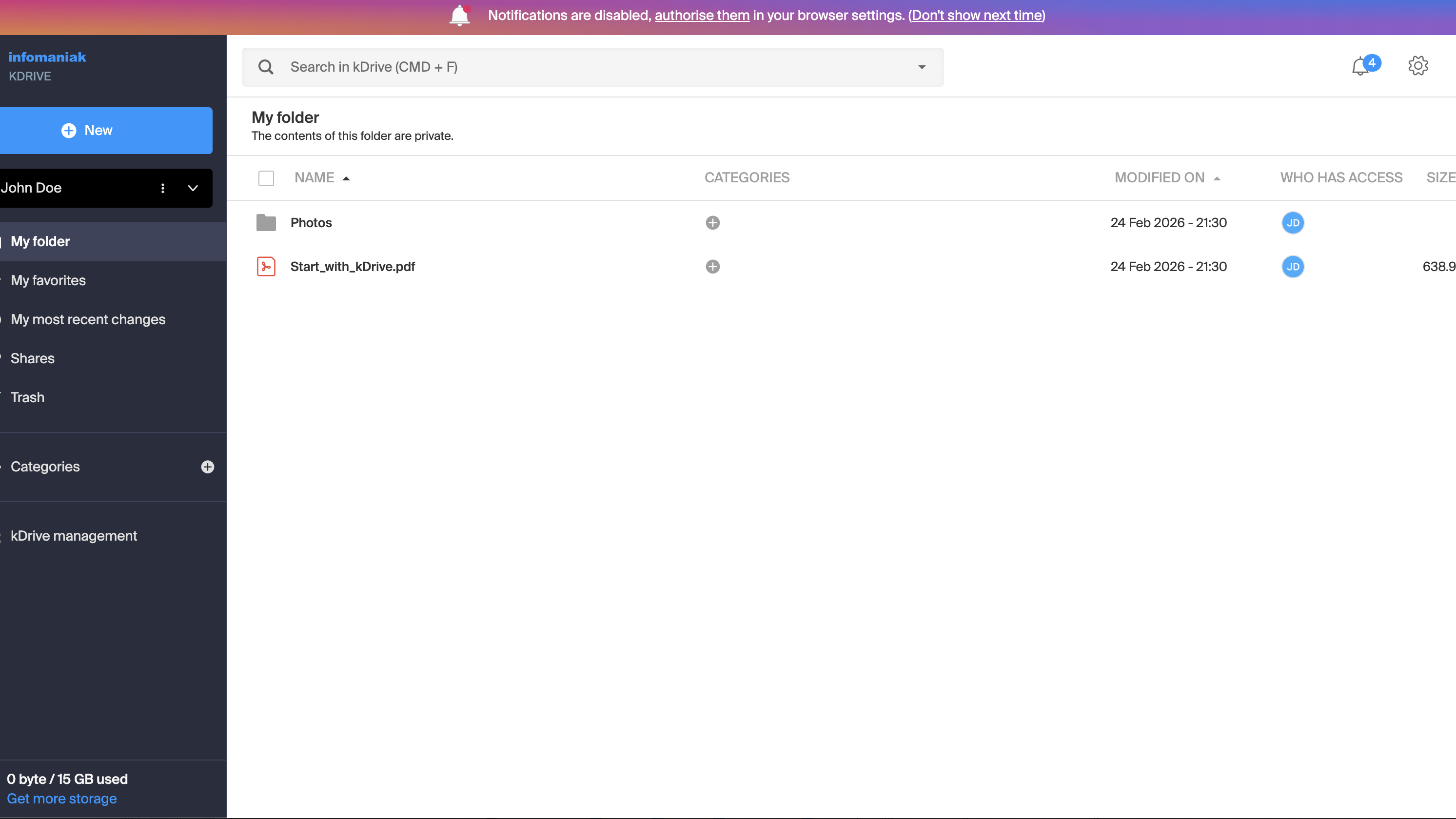
Infomaniak was founded in 1994 and is based in Geneva, Switzerland. Its current company explanation describes an independent company controlled by a charitable foundation. Earlier family-owned and acquisition-history claims have been removed.
Encryption: kDrive encrypts data at rest and in transit, according to the Infomaniak trust centre. That is not end-to-end encryption. Infomaniak's servers can process files for document editing. Do not choose it on the assumption that a promised client-key safe has already shipped.
Plans: the kDrive price list showed kDrive Solo at 3 TB for one user at €59.88 (list, checked 16 Sep 2026), or €5.54 (list, checked 16 Sep 2026) month to month, and kDrive Team from 3 TB for six users at €120 (list, checked 16 Sep 2026). Infomaniak advertises a discounted per-month equivalent rather than a yearly total, so the annual figures are that rate multiplied by twelve.
Best for: Teams that prioritise Swiss hosting and live document collaboration. Trade-off: Server access to document content differs from the end-to-end model of Proton Drive or Tresorit. Evaluate the chosen editor and sharing controls with representative documents.
Internxt
Internxt is based in Valencia, Spain, and was founded in 2020. Its About page lists outside investors. That does not establish a future acquisition date; the earlier prediction has been removed.
Encryption: Internxt describes its Drive as zero-knowledge and end-to-end encrypted, with AES-256 and Kyber-512 in its security and product claims. Post-quantum techniques are designed to resist future quantum attacks; they do not guarantee future security. We have not independently established its claimed market-first status.
Pricing: Official support describes annual subscriptions as a one-year commitment billed monthly, with introductory discounts applying to the first month, not the whole first year. At twelve times the full monthly rate that is €119.88 (list, checked 7 Oct 2026) for Essential 1 TB, €239.88 (list, checked 7 Oct 2026) for Premium 2 TB and €359.88 (list, checked 7 Oct 2026) for Ultimate 5 TB. Your actual first-year total will be lower than those figures because of the discounted first month, and higher in later years if the rate changes, so check the ongoing monthly charge and the commitment before buying. The plan matrix also lists 1 GB free and lifetime tiers starting at €380 (promo, was €1900, checked 7 Oct 2026).
Security and features: Internxt reports a second Securitum audit with no severe vulnerabilities and separately states ISO 27001 certification. This is provider-reported evidence, not an assurance that vulnerabilities cannot exist. Product availability varies by plan, and features labelled “coming soon” should not drive a purchase today.
Best for: People who want another European encrypted-storage option and are willing to evaluate its apps. Trade-off: Verify ongoing billing and needed features carefully; the introductory discount is a poor guide to the full contract cost.
How do the closest pairs compare?
Two of these five get shortlisted against each other more often than any other combination. Here is each pairing in a single paragraph.
pCloud vs Proton Drive, in 60 words
pCloud is the value choice for a large, long-lived archive: lifetime tiers to 10 TB, a mature Linux desktop client, and built-in media playback. Proton Drive is the privacy choice: files and filenames are end-to-end encrypted by default, with encrypted Docs and Sheets included. Matching that on pCloud means buying Crypto separately, and it protects one folder only.
Longer version: pCloud vs Proton Drive.
Proton Drive vs Tresorit, in 60 words
Both encrypt end to end by default, so the split is audience. Proton Drive is built for individuals who want storage bundled with mail, calendar, VPN and a password manager under one Swiss account. Tresorit is built for organisations: granular permissions, ISO 27001:2022 certification, data rooms, and a HIPAA business associate agreement available separately from the storage subscription.
Which one would we choose?
For personal encrypted files, start by comparing Proton Drive with Internxt. Proton makes particular sense if you already use its other services. For collaborative documents, shortlist kDrive, accepting its different encryption model.
For controlled business sharing, evaluate Tresorit against your required permissions, audit workflow and contract. For media storage and an upfront payment, pCloud is worth considering with the selected region and any Crypto cost included.
Tresorit — Swiss zero-knowledge cloud
End-to-end encrypted Swiss storage with BAA-ready Business plans. Even Tresorit can’t read your files.
Affiliate partnership — we may earn a commission at no cost to you.
There is no universal winner. A useful trial is a round trip: upload a representative folder, open files on your actual devices, share with a collaborator, then export and restore a sample. This reveals workflow gaps a pricing table cannot show.
Switching is easier than you think
The general process is the same regardless of which provider you choose:
- Export your files from your current provider (Google Takeout, Dropbox download, OneDrive export)
- Upload to your new European provider, desktop apps handle large libraries best
- Verify a sample of files across folders to confirm nothing was corrupted or lost
- Reconfigure any app integrations pointing to your old storage
Keep both accounts active for 1–2 weeks. Don't delete your old provider until you've confirmed everything transferred correctly, shared links are updated, and collaborators have been re-invited.
For step-by-step migration instructions for each provider, see our cloud storage category page. If you're coming from Dropbox or Google Drive specifically, check out our dedicated guides for Dropbox alternatives and Google Drive alternatives.
Related resources
Products Mentioned
kDrive is a secure online storage solution developed by Infomaniak, offering collaborative tools and data management in a sovereign cloud environment. It allows users to store, share, and collaborate on files with integrated Microsoft Office tools, ensuring data security and compliance with European regulations.
Internxt offers encrypted cloud storage solutions with a focus on privacy and security. It provides a range of services including Drive, VPN, and Antivirus, ensuring data protection through advanced encryption methods. Internxt is committed to user privacy, employing end-to-end encryption and post-quantum cryptography to keep user data secure and private.
pCloud is a Swiss-based cloud storage solution that prioritizes data privacy and security. Offering various plans, it allows users to store, access, and manage files with strong encryption and flexible sharing options.

Proton Drive is a secure cloud storage service that allows users to store, share, and collaborate on files with end-to-end encryption. It offers features like file syncing, secure file sharing, and online document editing. Proton Drive is based in Switzerland and is protected by European privacy laws.
Tresorit is a Swiss-Hungarian end-to-end encrypted cloud storage and collaboration platform founded in 2011 by Istvan Lam, Szilveszter Szebeni, and Gyorgy Szilagyi. Headquartered in Zurich and acquired by Swiss Post in 2021 (while remaining independently operated), Tresorit uses zero-knowledge RSA-4096 encryption — meaning even Tresorit staff cannot access your files. The platform serves businesses that handle sensitive data: legal firms, healthcare, finance, and government. Beyond basic cloud storage, Tresorit offers secure data rooms (Tresorit Engage), electronic signatures (eSign), and email encryption.
Related Articles
The European Digital Sovereignty Stack: A US-to-EU Replacement for Every Service (2026)
A practical, honestly audited map of the European replacement for every US service you use, from email and cloud storage to search, browsers, messaging, and payments. Real vendors, where each one is actually headquartered, who owns it, and the gaps where Europe has no answer yet.
Data & ResearchEuropean Digital Sovereignty Incidents 2018-2026: Complete Catalog
Every publicly documented case of US legal compulsion, sanctions, and forced acquisitions reaching European data and officials since GDPR. Two-source rule, ISO dates, primary citations only.
ReviewsBunny CDN Review 2026: An Honest Take After Migrating builtineu.eu
An honest Bunny.net review after putting it in front of builtineu.eu. Five days of dashboard data, a 90% cache hit rate, a $0.01 bill, and where Cloudflare still wins.
Ready to Switch to EU Alternatives?
Explore our directory of 400+ European alternatives to US tech products.
