
The European SaaS Stack 2026: A Working Blueprint Without AWS, Stripe, or Cloudflare
A practical 7-layer European SaaS stack for 2026. Hosting, database, transactional email, payments, CDN, analytics, and authentication, with the right vendor for each layer and the honest gaps where the European answer is still self-host.
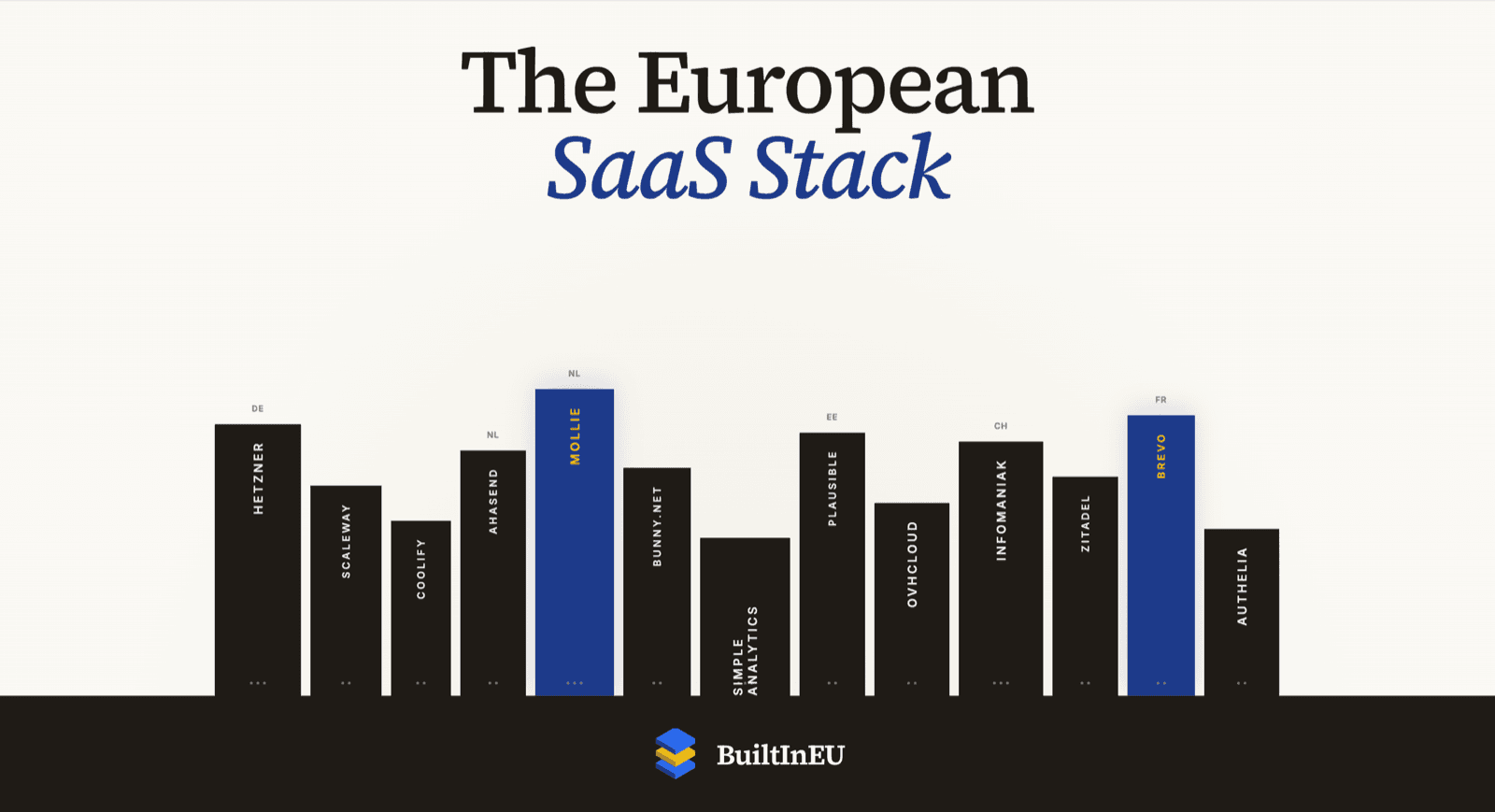
Quick answer: Yes, you can build a complete SaaS on European-only infrastructure in 2026. The working 7-layer stack is Hetzner or Scaleway for hosting, self-hosted Postgres via Coolify for the database, AhaSend or Brevo for transactional email, Mollie for payments, Bunny.net for the CDN, Simple Analytics or Plausible for analytics, and Zitadel, Authelia, or Keycloak (self-hosted on European infrastructure) for authentication.
European cloud sovereignty stopped being theoretical this week. On 7 May 2026, CNBC reported that the European Commission is weighing restrictions on the use of US cloud platforms for sensitive government data. Two days earlier, the EU committed €180 million directly to European cloud providers. Two weeks before that, the bloc named four sovereign cloud finalists for its own infrastructure. The momentum at the infrastructure layer mirrors what is happening above it: Europe's fifteen largest private AI companies are now worth a combined $73 billion, with foundation-model labs in Paris and London raising rounds the size of small national budgets.
The question for founders and CTOs is no longer "should we care about European infrastructure?" It is "can we actually build a SaaS without Amazon, Stripe, and Cloudflare?" The longer answer is below: a practical 7-layer stack for 2026, with the right European vendor for each layer, the comparisons that matter (Hetzner vs AWS, Mollie vs Stripe, Bunny.net vs Cloudflare, Plausible vs Google Analytics), and the honest gaps where the European answer is still self-host or accept a workaround.
A note on what "European" means here. A vendor qualifies if its parent company is headquartered in the EU, EEA, UK, Switzerland, or an EU candidate country. A US company with a Frankfurt data centre does not, because the US CLOUD Act applies to the parent regardless of where servers physically sit. Open-source projects with US parent companies still qualify when you self-host on European infrastructure, since at that point your jurisdiction is European even if the upstream maintainer's is not. We flag those cases below.
The European SaaS Stack · 2026
Seven layers, seven European picks
| # | Layer | Recommended | Alternates · what it replaces |
|---|---|---|---|
| 01 | Hosting & compute Where the application runs | HetznerDE Price-performance leader. €4.51/mo and up. | FRScalewayFROVHcloudCHInfomaniakFIUpCloudCHExoscale Replaces · AWS · Google Cloud · Azure |
| 02 | Database Where the data lives | Postgres via CoolifyHU Self-hosted on the same Hetzner box. Apache 2.0. | FRScaleway Managed PGFROVHcloud Managed DBOSSelf-hosted Supabase Replaces · RDS · Supabase Cloud · Neon · Aiven |
| 03 | Transactional email Receipts, password resets, confirmations | AhaSendNL Developer-first. 1,000 emails/mo free. | FRBrevoFRMailjetLTMailerLiteNLLettermint Replaces · SendGrid · Postmark · Resend · Mailgun |
| 04 | Payments Taking money from customers | MollieNL iDEAL, Bancontact, SEPA, Klarna built in. ~1.8% + €0.25. | NLAdyenNLBuckarooUKPaddle (MoR)SEKlarna Replaces · Stripe · Braintree · Square |
| 05 | CDN Fast asset delivery worldwide | Bunny.netSI $0.01/GB. 119+ PoPs across 82 countries. | LUGcoreCHKeyCDN Replaces · Cloudflare · Fastly · CloudFront |
| 06 | Analytics Who is using the product | Simple AnalyticsNL Cookieless. No consent banner needed. From €19/mo. | EEPlausibleDEPirschOSSelf-hosted Matomo Replaces · Google Analytics · Mixpanel · Amplitude |
| 07 | Authentication Login, SSO, 2FA | Zitadel (self-host)CH European Auth0 equivalent. Apache 2.0. Self-host on Hetzner; Cloud runs on GCP. | OSAutheliaOSKeycloakDERauthyDEBare.ID (managed) Replaces · Auth0 · Clerk · Cognito · Firebase Auth |
The seven layers above are the order you will hit them when building. The rest of this post takes them one by one, with the picks that matter, the comparisons people actually search ("Hetzner vs AWS", "Mollie vs Stripe", "Bunny.net vs Cloudflare"), and the honest gaps where the European answer is still self-host.
1. Which European cloud should I use for hosting?
This is the foundation, and the European market is strongest here. The honest one-line summary: Hetzner if you can run Linux, Scaleway if you want the AWS developer experience, Infomaniak if you want someone else to manage everything for you. The rest is detail.
Hetzner Cloud
Germany
The price-performance leader in Europe. Cloud servers from €4.51/mo, dedicated bare metal, generous specs. Best when your team can run Linux.
Scaleway
France
The closest European parallel to AWS. Managed Kubernetes, databases, serverless functions, GPU instances. Smooth migration path off AWS.
Hetzner: the unbeatable price-performance king
Hetzner is German, headquartered in Gunzenhausen, founded in 1997, with data centres in Falkenstein and Nuremberg (Germany) and Helsinki (Finland). Among self-hosters, indie SaaS founders, and anyone who has run a real Linux box, Hetzner is the default answer. The reason is unit economics that genuinely beat the US hyperscalers: a CPX31 cloud server (4 vCPUs, 8 GB RAM, 160 GB SSD) costs roughly €16 per month. The closest AWS shape (m6i.xlarge) is several times that. Hetzner also runs a legendary "Server Auction" where you can rent older bare-metal dedicated servers (think 64 GB RAM, multi-TB storage) for the price of a small VPS elsewhere.
The trade-off is operational. Hetzner gives you a Linux box. Anything above the operating system you bring yourself, or you use a layer like Coolify on top to get a Heroku-shaped developer experience. For teams with any Linux capability, this is the single biggest cost lever in the European stack.
Hetzner vs AWS, in 60 words
Hetzner is roughly 5 to 10 times cheaper than AWS for equivalent compute. Hetzner runs in EU data centres in Germany and Finland, sits under GDPR jurisdiction, and is unaffected by the US CLOUD Act. AWS retains an edge on managed services and global edge presence. For a typical SaaS that does not need 30 regions of edge compute, Hetzner wins on cost; AWS wins on managed-service breadth.
Scaleway: closest to the AWS developer experience
Scaleway is French, headquartered in Paris, owned by the Iliad Group, founded in 1999 (originally as Online.net). Their EU-region data centres host the broadest managed-service catalogue in European cloud: managed Kubernetes (Kapsule), managed PostgreSQL and Redis, S3-compatible object storage, serverless functions and containers, GPU instances, a load balancer. Pricing sits between Hetzner and the US hyperscalers, which is the trade you make for the polished managed services.
For a team migrating from AWS that wants to keep the same mental model (Lambda + EKS + RDS + S3 → Functions + Kapsule + Managed DB + Object Storage), Scaleway is the lowest-friction step in Europe.
Infomaniak: managed everything, Swiss premium
Infomaniak is the closest thing the European market has to a one-stop managed hosting shop. Geneva-based, founded in 1994, employee-owned, operating exclusively from Swiss data centres on 100% renewable energy. Their range covers managed web hosting, kSuite (a sovereign Google Workspace replacement: Mail, Drive, Docs, Calendar, Meet), Public Cloud (managed OpenStack), and Jelastic PaaS for one-click application deployment. Switzerland's Federal Act on Data Protection (FADP) is stricter than the EU's GDPR.
The honest trade: Infomaniak costs more than Hetzner per vCPU, and the catalogue is shallower than Scaleway's. The reason to pick Infomaniak is when you specifically want a fully managed Swiss-jurisdiction environment without ever touching a Linux terminal. For a non-technical founder or an agency handling regulated client data, that is exactly the right trade. If that matches your team, start with Infomaniak Public Cloud (affiliate link).
Hetzner vs Infomaniak vs Scaleway, in 60 words
Hetzner wins on price-performance: cheap, fast, unmanaged, German. Scaleway wins on developer experience: AWS-shaped managed services in Europe, French. Infomaniak wins on managed simplicity and Swiss jurisdiction: more expensive, fewer raw services, but you never touch the OS, and your data sits under the strictest privacy law in the European space. Pick by whether your team's bottleneck is cost, complexity, or compliance.
OVHcloud, UpCloud, Exoscale
OVHcloud is the largest European cloud provider by revenue. French, Roubaix-headquartered, founded in 1999. Bare metal, public cloud (OpenStack-based), private cloud, managed databases. Heavier on enterprise sales motion than Scaleway, but the platform is genuine.
UpCloud is Finnish, founded in 2011. Focused on raw performance. Their MaxIOPS storage tier is genuinely fast and underrated for database-heavy workloads.
Exoscale is Swiss, based in Lausanne, founded in 2011. Strong managed-Kubernetes story (their SKS service is well-regarded in DACH markets). A solid alternative to Scaleway for compliant, sovereign Swiss infrastructure with a cleaner UX than the giants.
With the compute layer settled, the next decision is where the data lives.
2. Where should I host my Postgres database in Europe?
The honest answer: most teams should self-host Postgres on a European cloud rather than use a managed-database product. The reason is egress. When the application server and the database live on the same machine or in the same VPC, traffic between them costs nothing. When they live on different providers, the database egress bill stays with you forever.
Coolify
Hungary
Open-source PaaS. Self-hosted on your Hetzner box. One-click services for Postgres, Redis, Supabase, MySQL. The cheapest path to a real database.
Scaleway Managed PG
France
Managed PostgreSQL on European infrastructure. Real Postgres, exportable any time. The right pick when self-hosting is more risk than your team wants.
Self-host Postgres via Coolify
Coolify is an open-source self-hosted PaaS, built by András Bácsai in Hungary, founded in 2021. It runs on your own Hetzner, Scaleway, or OVHcloud machine and gives you a Vercel-style deployment experience for Next.js, Node, Python, Rails, and so on. It also has one-click services for Postgres, Redis, MySQL, MongoDB, and the full open-source Supabase distribution. Apache 2.0 license. Nearly 50,000 stars on GitHub as of 2026.
For most early-stage SaaS workloads, this is the cheapest and most jurisdictionally clean answer: one Hetzner box running both the app and Postgres via Coolify, total cost in the low double-digit euros per month.
Self-hosted Supabase (open-source distribution)
The Supabase platform is open source under the Apache 2.0 / PostgreSQL licenses. The full set of containers (Postgres, GoTrue auth, PostgREST, Realtime, Storage, Kong gateway, Studio) can be deployed onto any server you control via Coolify's one-click Supabase service or directly via the official Docker Compose stack. Once it runs on European infrastructure, the entire Supabase developer experience sits under European jurisdiction. The hosted version, in contrast, is operated from the US.
Scaleway and OVHcloud managed Postgres
If self-hosting the database is more operational risk than your team wants to absorb, Scaleway Managed Database for PostgreSQL and OVHcloud managed databases both run real Postgres on European infrastructure under European jurisdiction. They are exportable any time, no proprietary lock-in.
Database sorted. Next, the layer most SaaS founders underestimate.
3. What is the best European transactional email service?
Every SaaS sends transactional email: password resets, account confirmations, receipts. The European market here is unusually deep, with two genuinely strong picks for different shapes of team plus several solid alternatives.
AhaSend
Netherlands
Developer-first transactional email. 1,000 emails/month free, clean API, raw delivery logs, sandbox mode, scoped API keys. No marketing-tool clutter.
Brevo
France
Transactional + marketing + basic CRM in one. 300 emails/day free with unlimited contacts. The broadest single-tool option in Europe.
AhaSend: the developer-first transactional pick
AhaSend is Dutch, headquartered in Amsterdam (AhaSend B.V., Willem Fenengastraat 16), with infrastructure across four European countries. The pitch is the cleanest in the European space if you want a sharp tool for one job: transactional-only, no marketing features in the way, designed for developers. The free tier covers 1,000 emails per month with no credit card required, which is comfortable for an early-stage SaaS.
What makes it stand out from generic SMTP relays:
- Sandbox mode that mirrors production for end-to-end testing without sending real email.
- Idempotency keys so you can safely retry on network failures.
- Scoped API keys (per-action, per-domain) for least-privilege architectures.
- Raw delivery logs with the actual SMTP error messages from receiving servers, not abstracted summaries.
- CLI tool for managing the account, streaming webhooks to localhost, and triggering events without leaving the terminal.
- Dedicated IPs (free at high volumes) and BYOIP for teams migrating from SendGrid.
If you want to try it, AhaSend's free tier is the easiest way in. (Disclosure: this is our affiliate link. Same price for you, small commission for us, doesn't influence the recommendation.)
Brevo: broader free tier, marketing built in
Brevo (formerly Sendinblue) is French, based in Paris, founded in 2007. The free tier is the most generous on the marketing side of European email: 300 emails per day across both transactional and marketing, plus unlimited contacts. The platform combines transactional API, SMTP relay, marketing email campaigns, transactional template management, and a basic CRM in one dashboard. The right pick for a solo founder or small team running both a newsletter and password-reset emails who would rather use one tool than two. Want to try it? Brevo's free plan is the easiest way in (affiliate link).
Mailjet, MailerLite, Lettermint, Forwardemail
Mailjet is French, founded in 2010 in Nantes. In December 2021 it was acquired by Sinch (Stockholm, Sweden) as part of the $1.9 billion Pathwire deal. The platform sits cleanly in the European corporate hierarchy: French operations, Swedish parent, EU-region infrastructure. Slightly more developer-leaning than Brevo.
MailerLite is Lithuanian, based in Vilnius, founded in 2010. Lean, marketing-leaning more than transactional. The free plan covers 1,000 contacts and 12,000 emails per month, competitive with Brevo for a smaller list.
Lettermint is also Dutch, similar shape to AhaSend, 300 emails per month free. Newer, smaller.
Forwardemail solves a related but different problem: privacy-respecting email forwarding for custom domains. Not a transactional API, but worth knowing about for the email-related layer.
With email flowing, the next question is how you actually take money from customers.
Brevo — European email + CRM
Paris-headquartered marketing platform covering transactional email, newsletters, SMS, and a free CRM. GDPR-native, with a 300-emails/day free tier.
Affiliate partnership — we may earn a commission at no cost to you.
4. What is the best European alternative to Stripe?
If your customers are European, this is the layer where the European stack is genuinely competitive with Stripe rather than dragging behind it.
Mollie
Netherlands
The European Stripe. Clean API, every EU payment method built in (iDEAL, Bancontact, SEPA, Klarna). Subscriptions and recurring payments included.
Adyen
Netherlands
Enterprise-grade Dutch processor. Powers Spotify, Uber, eBay. Where you graduate to when Mollie's per-transaction fee starts to hurt.
Mollie: the European Stripe
Mollie is Dutch, founded in 2004 in Amsterdam. The closest API and developer experience to Stripe in Europe. Out of the box you get every European payment method that matters: iDEAL (Netherlands), Bancontact (Belgium), SEPA Direct Debit, Klarna (BNPL), credit cards, Apple Pay, Google Pay. Subscription billing, recurring payments, multi-currency. The integration pattern (create payment, redirect customer, process webhook) is identical to Stripe's.
The free tier is genuinely free. Pricing is per-transaction with no monthly minimum. Standard European cards typically cost 1.8% plus €0.25, which is comparable to Stripe.
Mollie vs Stripe, in 60 words
Mollie and Stripe both offer modern payment APIs with subscription support, webhooks, and SCA-compliant flows. The differences are jurisdiction (Mollie is Dutch under PSD2 and GDPR; Stripe is US under the CLOUD Act), local payment method coverage (Mollie supports iDEAL, Bancontact, and SEPA natively from day one), and pricing (Mollie tends to be slightly cheaper per transaction with no monthly minimum). Mollie wins for European-focused SaaS; Stripe still leads on global reach.
Adyen, Klarna, Buckaroo, Paddle
Adyen is Dutch, founded in 2006, publicly listed. Enterprise-shaped rather than developer-shaped. If your processing volume is high enough that the Mollie per-transaction fee starts to matter, Adyen is where you graduate to. Powers Spotify, Uber, eBay, and Microsoft.
Klarna is Swedish, primarily a buy-now-pay-later option. Worth integrating as a payment method (often via Mollie or Adyen) rather than as your primary processor.
Buckaroo is Dutch, a Mollie alternative with a deeper Dutch market focus and broader integration with Dutch enterprise systems.
Paddle is UK-headquartered, founded in 2012. Operates as a Merchant of Record: they handle VAT collection, EU sales tax compliance, and chargebacks for you. If you sell to global customers and do not want to handle VAT MOSS yourself, Paddle keeps you out of US payments while solving the tax-compliance problem. The trade-off is that they take a noticeably higher cut than Mollie or Adyen.
Money flowing. The next layer is delivery: how fast pages and assets actually reach the user.
5. What is the best European CDN?
A small layer with a clean answer.
Bunny.net
Slovenia
Pay-per-use ($0.01/GB), 119+ PoPs globally, edge storage and image optimisation built in. Cleanest dashboard in the European CDN space.
Gcore
Luxembourg
Larger global PoP network than Bunny.net. More enterprise-shaped pricing and onboarding. The right pick for high-volume international workloads.
Bunny.net: pay-per-use, Slovenian
Bunny.net is Slovenian, headquartered in Ljubljana, founded in 2014. They run a CDN with 119+ Points of Presence across 82 countries, plus edge storage, image optimisation, video delivery, and DDoS protection. The pricing model is pure pay-per-use, starting at $0.01 per GB transferred, which makes Cloudflare Pro's flat rate look expensive at typical SaaS workloads. Dashboard is clean, API is well-documented.
For most SaaS workloads (cache static assets, optionally do image transforms, optionally serve video), Bunny.net covers everything you need. EU-owned and EU-operated. If you want to spin up a pull zone, Bunny.net's signup is two minutes and the first $1 covers a small site for a month (affiliate link).
Bunny CDN vs Cloudflare, in 60 words
Bunny.net is a Slovenian CDN with pay-per-use pricing (around $0.01 per GB transferred) and 119 PoPs globally. Cloudflare is a US-headquartered CDN with a flat-rate pricing model and 300+ PoPs. For European-sovereign hosting, Bunny.net is the GDPR-native and CLOUD-Act-free choice. For workloads with very high traffic and predictable global distribution, Cloudflare's flat rate sometimes wins on cost.
Gcore, KeyCDN, Fastly
Gcore is Luxembourg-headquartered, founded in 2014 (originally as G-Core Labs in Russia, since reincorporated in Luxembourg). Strong global PoP network, more enterprise-shaped than Bunny.net.
KeyCDN is Swiss, operated by proinity LLC. Similarly transparent pay-per-use pricing model. Smaller PoP network than Bunny.net.
Fastly is American (San Francisco). It appears on European-stack lists because of its UK presence, but the parent company is US and the CLOUD Act applies. If sovereignty is the goal, Fastly does not pass.
With the CDN in place, you need a way to see how visitors are actually using the site.
Bunny.net — the no-fluff European CDN
Slovenia-based CDN with usage-based pricing from $0.01/GB. Edge storage, image optimisation, and video streaming on the same dashboard.
Affiliate partnership — we may earn a commission at no cost to you.
6. What is the best European Google Analytics alternative?
You almost certainly do not need Google Analytics. You probably do not even want it, given the consent-banner overhead.
Simple Analytics
Netherlands
Cookieless, no consent banner needed. Dashboard shows the metrics that matter. Lightweight script (under 3 KB). Plans from €19/mo.
Plausible
Estonia
Open-source, self-hostable for free. Managed plan from €9/mo. Closest direct alternative to Simple Analytics in feature surface and philosophy.
Simple Analytics: cleanest privacy-first option
Simple Analytics is Dutch, headquartered in Rotterdam, founded in 2018. Cookieless, no personal data collected, no consent banner needed under GDPR. The dashboard shows the metrics that actually matter (page views, referrers, top pages, real-time visitors) and skips the ones nobody actually checks. Plans start around €19 per month with a free trial.
Plausible: open source, self-host or managed
Plausible is Estonian, headquartered in Tallinn, founded in 2018. Open source under AGPL. Self-host is free; the managed plan starts around €9 per month for the smallest tier. The closest direct competitor to Simple Analytics in feature surface and philosophy. The choice between them tends to come down to UX preference and pricing tier rather than capability.
Plausible vs Google Analytics, in 60 words
Plausible is a privacy-first, open-source analytics tool from Estonia. Google Analytics is a free analytics tool from the United States. The differences are cookies (Plausible uses none; GA4 uses several), GDPR posture (Plausible is GDPR-compliant by default and needs no consent banner; GA4 typically requires one), pricing (Plausible starts around €9 per month; GA4 is free in exchange for your visitor data), and feature depth (GA4 is significantly more powerful; Plausible is more readable).
Matomo (caveat), Pirsch, Counter.dev
Matomo appears on most European-alternative lists, but the company behind it (InnoCraft Ltd) is registered in Wellington, New Zealand, not Europe. Matomo Cloud is therefore operated from a non-European jurisdiction. Self-hosted Matomo, however, is open source under GPL. When you run it on your own European infrastructure, the data plane is fully under your jurisdiction. We list it here only because the self-hosted route remains a legitimate European-stack option.
Pirsch is German, self-hostable, with a clean managed offering. Underrated and worth a closer look if you want a pure German privacy-first option.
Counter is the minimalist option. Almost no features, almost no cost. Suitable for a personal blog more than a SaaS dashboard.
And finally, the layer that turns visitors into users.
7. Which European authentication platform should I use?
Two picks cover the vast majority of teams. Zitadel if you want a full identity platform with multi-tenancy, social login, SAML, and a polished admin UI. Authelia if you want a lightweight self-hosted SSO and 2FA portal in front of your existing apps. Both are open source and self-hostable on European infrastructure.
Zitadel
Switzerland
The European Auth0. Multi-tenant OIDC + SAML, social login, passkeys, modern UI. Apache 2.0, self-hostable. Founded 2019 in St. Gallen.
Authelia
Community-maintained
Lightweight self-hosted SSO and 2FA portal. No corporate parent. Pairs cleanly with Traefik or nginx in front of internal apps.
Zitadel: the European Auth0
Zitadel is the closest European answer to Auth0 or Okta CIC: a full multi-tenant identity platform with OIDC, SAML, social login, MFA, passkeys, and RBAC. Founded in 2019 by Zitadel AG in St. Gallen, Switzerland. Apache 2.0 licensed. Used in 69 countries, $9 million Series A in 2023.
One caveat worth knowing: Zitadel Cloud runs on Google Cloud Platform, including the "EU" and "Switzerland" regions. For strict European sovereignty, self-host Zitadel on Hetzner, Scaleway, or OVHcloud. For teams that want a Swiss-incorporated cloud auth vendor and accept the GCP underlay, Zitadel Cloud is fine.
Authelia: the lightweight self-hosted pick
Authelia is Apache 2.0, maintained by a distributed community, with no single corporate parent. It focuses on self-hosted SSO and 2FA in front of services and pairs well with Traefik or nginx as a reverse proxy. The right pick when you do not need a full identity platform and just want a clean login portal in front of your own apps.
Other European options worth knowing
If neither pick fits your shape:
- Keycloak for enterprise-feature-rich IAM (Apache 2.0, donated to CNCF in 2023; self-host on European infrastructure to keep the data plane European).
- Bare.ID for managed Keycloak in German data centres (AOE Group, Wiesbaden, ISO 27001, customers include Deutsche Telekom).
- Rauthy for a modern Rust OIDC provider that ships as a single binary (German maintainer, Apache 2.0, security-audited).
- privacyIDEA for MFA token lifecycle management on top of LDAP, RADIUS, SSH, and hardware tokens (NetKnights, Kassel).
Logto and Pomerium are excellent open-source projects but US-parented (Delaware and California respectively). Self-host either on European infrastructure if you want the codebase; do not use their hosted offerings for a sovereign stack.
Seven layers covered. Before the cost picture, here is what the European stack still does not do well.
Where does the European SaaS stack still have gaps?
This is the part most articles skip. We will not.
Managed serverless. AWS Lambda and the Google and Microsoft equivalents remain ahead of European options for low-latency, high-concurrency function workloads. Scaleway Functions exists; Coolify can run cron jobs and one-shot containers; nothing in Europe yet has the polished developer experience of Lambda plus API Gateway plus DynamoDB stitched together.
Wide-column / NoSQL at hyperscale. No clean European equivalent to DynamoDB or Bigtable at the hundreds-of-terabytes tier. ScyllaDB and FoundationDB exist, but they are self-host plus operational overhead, not a managed service.
Specific managed niches. Hyperscale message queues like SQS, large-language-model APIs at production volume, and IoT-grade pub/sub. The European answer in each case is either self-host an open-source equivalent (NATS, RabbitMQ, Kafka) or accept a US dependency for that specific layer.
The honest take: a European stack covers the foundation and the application layer. The further up the AWS service portfolio you climb, the thinner the European answer gets. For most SaaS workloads up to the low-millions-of-active-users scale, none of these gaps are blockers.
How much does a European SaaS stack cost?
A typical small-to-mid European stack (one Hetzner CPX31 running app and Postgres via Coolify, Brevo for email, Mollie for payments, Bunny.net CDN, Simple Analytics) lands at roughly €25 to €45 per month at startup scale. The equivalent US stack (Vercel Pro plus Supabase Pro plus Stripe plus SendGrid plus Cloudflare Pro plus Google Analytics 4) typically lands somewhere between $80 and $150 per month at the same workload, depending on egress and serverless invocation patterns.
The savings come mostly from compute (Hetzner is several times cheaper per vCPU than the US hyperscalers) and from egress (intra-server traffic on a single host costs nothing, where AWS-style architectures often charge per GB).
The European email, payments, and analytics layers are within the same cost range as the US equivalents. The CDN sits roughly in the middle. The compute layer is where the real cost lever is.
Frequently asked questions
Is there a European alternative to AWS?
Yes. Hetzner (Germany), Scaleway (France), OVHcloud (France), UpCloud (Finland), and Exoscale (Switzerland) are all production-grade European cloud providers. None of them has the full breadth of AWS managed services (no direct Lambda equivalent at parity, no DynamoDB at hyperscale), but for compute, storage, managed databases, and managed Kubernetes, the European market is genuinely competitive. Hetzner wins on price; Scaleway has the closest developer experience to AWS.
Can I scale a SaaS to thousands of users on Hetzner?
Yes. A single Hetzner CPX31 (4 vCPUs, 8 GB RAM, around €16/month) handles tens of thousands of monthly active users for a typical Next.js, Django, or Rails SaaS comfortably. Beyond that, you scale up to larger Hetzner Cloud servers (CCX series), then split application and database onto separate boxes, then add a CDN in front. The point at which you outgrow Hetzner Cloud entirely is well above the point at which most SaaS products would want to add a managed Kubernetes layer. At that scale, Scaleway Kubernetes Kapsule or Exoscale SKS becomes the next step.
What about US companies with EU regions? Do those count as European?
No. Under the US CLOUD Act, a US-headquartered company can be compelled by US law enforcement to hand over data regardless of where the data is physically stored. AWS Frankfurt, Azure North Europe, Google Cloud Belgium, Stripe's European entities, Neon and Aiven's EU regions, Auth0's EU region, all share this property. They are useful for latency, but they are not European in the jurisdictional sense. If the reason for going down this list is sovereignty, those options do not solve the problem.
Which European host is closest to the AWS developer experience?
Scaleway. Managed Kubernetes (Kapsule), managed databases, S3-compatible object storage, serverless functions, GPU instances. Its developer experience is the closest of any European provider to AWS Lambda plus EKS plus RDS plus S3. The trade-off is that Scaleway is more expensive than Hetzner and slightly less mature than AWS. For a team migrating from AWS that wants to keep its mental model, Scaleway is the lowest-friction step.
What about open-source platforms with US parent companies?
A nuance worth getting right. Several leading open-source identity and infrastructure projects (Keycloak, Logto, Pomerium) were created by US companies. The open-source codebases are licensed permissively (Apache 2.0 / MIT) and can be self-hosted. When you self-host an open-source project on European infrastructure, the data plane is fully European. The CLOUD Act applies to companies, not codebases. The hosted/managed offerings of those same companies are a different question and do not pass the European-jurisdiction bar.
How does this affect GDPR compliance compared to running on AWS Frankfurt?
GDPR compliance is significantly simpler. With a European-jurisdiction stack you avoid the standard contractual clauses (SCCs) overhead that comes with international data transfers, you avoid the Schrems II ambiguity that has now been re-introduced by US executive order changes, and you avoid the CLOUD Act exposure that the post-Schrems II framework was supposed to mitigate but does not fully. You still need to do the rest of GDPR (lawful basis, data subject rights, breach notification, DPIA where required), but the cross-border transfer chapter becomes much shorter.
What if I outgrow the European stack?
Three options. First, you scale up within the European stack. Hetzner has dedicated servers up to 64 vCPUs. Scaleway has GPU clusters and managed Kubernetes at production scale. OVHcloud has bare metal at any size. Second, you keep the European stack for everything that fits and add a US dependency only for the specific service you need (a US LLM API, for example), explicit and contained. Third, you self-host the missing piece. The point of starting on a European stack is not "no US technology forever". It is "no US technology by default".
How do I start building on a European SaaS stack?
If you are at the start of a SaaS build, the cheapest, fastest move is:
- Hosting: Hetzner CPX31, with Coolify on top for the developer experience.
- Database: Postgres via Coolify on the same Hetzner box. Move it to a dedicated machine when you outgrow shared compute.
- Transactional email: Brevo (free tier covers most early projects).
- Payments: Mollie. Stripe-shaped API, every European payment method built in.
- CDN: Bunny.net. Pay-per-use; you will pay €1 to €5 per month at typical small-SaaS volumes.
- Analytics: Simple Analytics or Plausible. Either is fine; the difference is largely aesthetic.
- Authentication: Authelia self-hosted in front of your app for simple SSO + 2FA. If you need a richer identity platform with multi-tenancy, social login, and SAML, self-host Zitadel or Keycloak on the same Hetzner box. Rauthy if you want a tiny single-binary OIDC provider; Bare.ID if you want managed Keycloak in German data centres.
Total bill at this scale: somewhere between €25 and €45 per month. GDPR posture: clean. Sovereignty posture: clean. Operational story: one server.
If you are migrating an existing SaaS from AWS plus Stripe plus Cloudflare, swap layer by layer rather than all at once. Pick the layer where the cost or sovereignty problem hurts most, swap that, validate it, then move to the next. The seven-step order below is the one we recommend for most teams: biggest cost levers first, highest-effort swap last.
Migration playbook · US → EU
Swap layer by layer, in this order
- 1HostingAWS · GCP · AzureHetzner + CoolifyBiggest cost lever. ~5–10× cheaper per vCPU.High
- 2PaymentsStripeMollieSame API shape. iDEAL, SEPA, Bancontact native.High
- 3CDNCloudflare · FastlyBunny.netPay-per-use beats flat rate at SaaS volume.Med
- 4EmailSendGrid · PostmarkAhaSend · BrevoDrop-in SMTP/API. Domain re-warming takes ~2 weeks.Med
- 5AnalyticsGoogle Analytics 4Simple Analytics · PlausibleRemoves the consent banner. Often a UX win on its own.Low
- 6DatabaseRDS · Supabase CloudPostgres on the Hetzner boxEliminates egress. Schedule downtime — plan a weekend.Med
- 7AuthAuth0 · Clerk · CognitoZitadel · Authelia · Keycloak (self-host)Highest-effort swap. Defer until other layers settle.Last
The European stack in 2026 is genuine, deep enough to run a real SaaS, and in most cases cheaper than the US default. The remaining question is no longer whether you can. It is whether the swap is worth it for your project. For most teams asking, the answer is yes.
Want to go deeper on any individual layer? The directory has the full vendor list for hosting, payments, email, CDN, analytics, authentication, and cloud storage. Or browse European alternatives to AWS, Stripe, Cloudflare, SendGrid, and Google Analytics directly.
Products Mentioned
Coolify is a portable personal cooling device designed to provide relief from heat. It features adjustable temperature settings and a lightweight, ergonomic design for easy carrying. The device can be used indoors or outdoors, and it operates quietly, making it suitable for various environments, including work and leisure activities.
Infomaniak Public Cloud is an IaaS platform built on OpenStack, operated by Geneva-based Infomaniak in their own Swiss data centers. It offers virtual machines, object storage (S3-compatible), managed Kubernetes, and load balancers with transparent per-hour pricing. Infomaniak runs its infrastructure on 100% renewable energy and maintains ISO 27001 certification, with all data stored exclusively in Switzerland.
Zitadel is an open-source identity and access management platform developed by the European company Zitadel. It provides developers with tools for user authentication, authorization, and secure data management. The platform supports various protocols and integrates easily with existing applications, ensuring a streamlined user experience.
Mollie is a payment service provider that facilitates online transactions for businesses. It supports various payment methods, including credit cards and digital wallets, to help streamline the checkout process. The platform offers easy integration with websites and provides tools for managing payments and analytics.
Bunny CDN is a CDN provider that offers image processing (f.e. scaling) and special services for video streaming.
Brevo (formerly Sendinblue) is a French marketing and transactional email platform founded in 2012 by Armand Thiberge in Paris. With over 500,000 customers including eBay, Volkswagen, and Michelin, Brevo has grown from an email marketing tool into a full customer communication suite covering email campaigns, transactional email API, SMS, WhatsApp, CRM, live chat, and marketing automation. All data is processed and stored in EU data centers. Brevo offers a genuinely usable free tier (300 emails/day) that makes it accessible for startups and small projects, with paid plans scaling from Starter through Enterprise.
AhaSend offers a Dutch cloud-based email marketing platform designed for SMBs, providing advanced segmentation and automation tools to enhance campaign effectiveness. It stands out with its transparent pricing model, ensuring no hidden fees, and supports GDPR compliance, making it ideal for businesses across Europe.
Rauthy is a lightweight Identity Provider supporting OpenID Connect, OAuth 2, and PAM. It is designed for easy setup and operation with secure defaults and flexible configuration options. The application emphasizes strong security, including Passkeys and passwordless login options, and is written in Rust for efficiency and speed.
Simple Analytics is a privacy-first alternative to Google Analytics, providing essential insights without using cookies or personal data. It is EU-based and complies with all major privacy regulations, making it an ethical choice for web analytics.
Scaleway is a cloud provider with a variety of services. Besides the public cloud called Scaleway Elements, they also offer dedicated servers and even renting racks in data centers.
Hetzner is a European cloud storage solution that offers reliable and affordable virtual servers hosted in Germany. Known for its competitive pricing, Hetzner provides a robust platform for businesses and individuals seeking efficient data storage and management solutions. With a focus on privacy and security, Hetzner ensures that all data is hosted within the EU, offering compliance with GDPR regulations and maintaining data sovereignty. This makes it an ideal choice for European businesses and privacy-conscious users who prioritize data protection. Hetzner's cloud storage services are particularly suited for small to medium-sized enterprises, developers, and IT professionals looking for cost-effective and scalable storage options. The pricing model is straightforward and paid, ensuring transparency and predictability in costs. Users can benefit from the peace of mind that comes with knowing their data is stored securely within the EU, adhering to strict data protection standards.
Bare.ID offers a German self-hostable authentication solution designed for developers seeking control over their identity management. It provides a customizable open-source platform, allowing seamless integration with existing systems while ensuring data privacy and compliance with local regulations.
Related Articles
The European Digital Sovereignty Stack: A US-to-EU Replacement for Every Service (2026)
A practical, honestly audited map of the European replacement for every US service you use, from email and cloud storage to search, browsers, messaging, and payments. Real vendors, where each one is actually headquartered, who owns it, and the gaps where Europe has no answer yet.
Digital SovereigntyWhat Is Digital Sovereignty? A Complete Guide for 2026
Digital sovereignty means controlling your own data and technology infrastructure. Learn why the EU is leading the global push for digital independence.
Digital SovereigntyComplete De-Googling Guide 2026: Replace Every Google Service Step by Step
Switching off Google takes about 8 to 16 hours of active work, spread over weeks. Practical guide to the European alternatives for every Google service, in the order that makes the migration easiest. Search and Browser first (30 minutes), Email and Photos last.
Ready to Switch to EU Alternatives?
Explore our directory of 400+ European alternatives to US tech products.
