
GDPR-Compliant Software: The Complete Guide for 2026
Every GDPR-compliant tool your business needs, sorted by category: email, cloud storage, CRM, analytics, project management, and more.
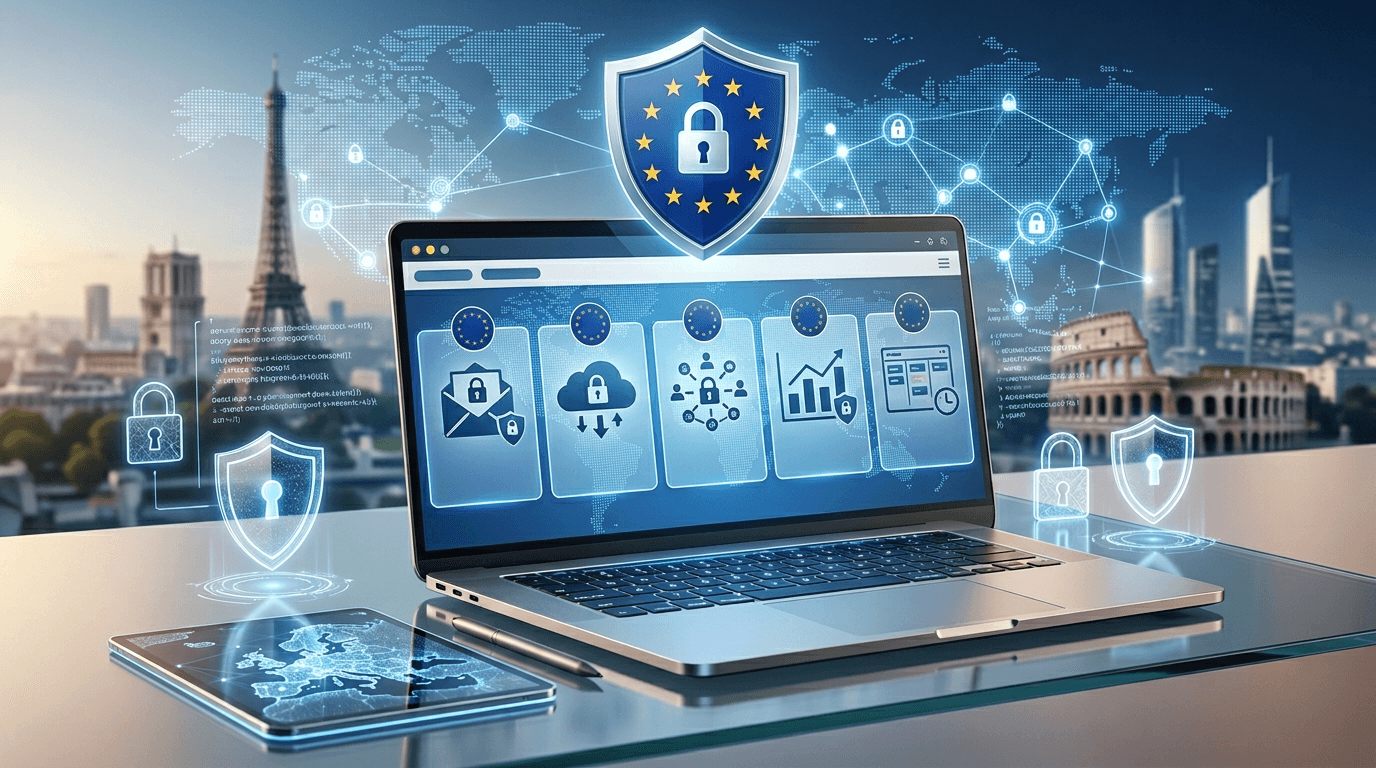
Quick answer: GDPR-compliant software keeps personal data under EU jurisdiction, offers a Data Processing Agreement under Article 28, encrypts data at rest and in transit, and uses no sub-processors outside the EU/EEA. The tools in this guide are headquartered in the EU, EEA or Switzerland and hosted in Europe, from Proton Mail and Tresorit to Nextcloud and Plausible.
Since the Schrems II ruling invalidated the EU-US Privacy Shield in 2020, any tool that transfers personal data to US servers creates legal risk for European businesses. The EU-US Data Privacy Framework (2023) provides some relief, but Austria's DSB and France's CNIL have both continued issuing enforcement actions against US data transfers through 2025. GDPR fines have now surpassed €5.8 billion across 2,245+ enforcement actions.
The straightforward fix: use software built and hosted in Europe.
This guide covers the best GDPR-compliant tools across every major software category. For each, we list the country of origin, encryption model, and what makes it a genuine alternative.
What Does GDPR Compliant Mean?
GDPR compliant means that a software provider meets all requirements of the EU General Data Protection Regulation, including lawful data processing, transparent privacy policies, proper consent mechanisms, and, critically, keeping personal data under EU jurisdiction. Not every tool that claims "GDPR compliance" actually delivers it. Here's what to look for:
Data residency. Where are the servers physically located? EU-hosted means your data stays under EU jurisdiction. This is the single most important factor.
Data processing agreements (DPAs). The provider should offer a clear DPA that outlines how they process personal data on your behalf. This is a legal requirement under Article 28 of the GDPR.
Encryption. End-to-end encryption ensures that even the service provider cannot access your data. At minimum, look for encryption at rest and in transit.
No third-country transfers. If the provider uses sub-processors outside the EU/EEA, your data may still leave Europe. Check their sub-processor list.
Transparency. Open-source software lets you verify privacy claims. Even with proprietary tools, look for published security audits and clear privacy policies.
The tools below meet these criteria. Most are headquartered in EU/EEA countries or Switzerland, store data exclusively in Europe, and offer proper DPAs.
GDPR-Compliant Email Services
Email is often the first place to start when building a compliant tech stack, it touches every part of your organization and contains some of your most sensitive communications.
Proton Mail (Switzerland) is the gold standard for privacy-focused email. End-to-end encrypted by default, open-source, and headquartered in Geneva. Their free tier is generous enough for personal use, with business plans starting at reasonable prices.
Tuta Mail (Germany) offers a similar level of encryption with servers exclusively in Germany. Their zero-knowledge architecture means even Tuta cannot read your emails.
Mailfence (Belgium) provides end-to-end encryption along with a full suite of productivity tools, calendar, contacts, documents, and groups. A solid choice for small teams wanting an all-in-one solution.
Posteo (Germany) stands out for its commitment to sustainability, powered by 100% renewable energy. Anonymous signup is available, and they accept cash payments for maximum privacy.
For email marketing specifically, Brevo (France) and rapidmail offer GDPR-compliant alternatives to Mailchimp with EU data hosting.
Brevo — European email + CRM
Paris-headquartered marketing platform covering transactional email, newsletters, SMS, and a free CRM. GDPR-native, with a 300-emails/day free tier.
Affiliate partnership — we may earn a commission at no cost to you.
GDPR-Compliant Cloud Storage
Storing files in the cloud is standard practice, but where those files are stored matters enormously under GDPR. US providers like Dropbox and Google Drive are subject to the CLOUD Act, which can compel them to hand over data to US authorities, even data stored on EU servers.
Nextcloud (Germany) is the most flexible option. Self-hosted or managed, it gives you complete control over where your data lives. It is open-source, extensible, and used by the German federal government.
Tresorit (Switzerland) focuses on end-to-end encryption for business file sharing. Zero-knowledge encryption means even Tresorit cannot access your files. Popular with legal firms and healthcare organizations.
pCloud (Switzerland) offers lifetime plans, pay once, use forever. Their optional pCloud Encryption feature adds client-side encryption for your most sensitive files.
Infomaniak kDrive (Switzerland) integrates cloud storage with an online office suite. A strong Google Workspace alternative for teams that want everything under one Swiss roof.
Internxt (Spain) is a newer entrant with a focus on zero-knowledge encryption and open-source transparency. Their free 10 GB plan makes it easy to try.
GDPR-Compliant CRM Tools
Customer data is some of the most sensitive information your business handles. Your CRM contains names, emails, phone numbers, purchase history, and communication logs, all of which fall squarely under GDPR's definition of personal data.
Pipedrive (Estonia) is built for sales teams. Headquartered in the EU with data centers in Europe, it offers a clean interface and strong pipeline management without the complexity of Salesforce.
SuperOffice (Norway) has been serving European businesses for over 30 years. Their CRM is designed with European data protection in mind from the ground up.
EspoCRM (Czech Republic) is open-source and self-hostable, giving you full control over your customer data. No license fees, no data leaving your infrastructure.
Teamleader (Belgium) combines CRM with project management and invoicing, ideal for European SMBs that want an all-in-one business tool.
GDPR-Compliant Analytics Tools
Web analytics was one of the first categories disrupted by GDPR enforcement. Multiple EU data protection authorities have ruled Google Analytics non-compliant, with Austria, France, Italy, and Denmark all issuing formal decisions against it.
Plausible (Estonia) is lightweight, open-source, and cookie-free. It collects no personal data whatsoever, which means you do not even need a cookie consent banner. Under 1 KB script size.
Pirsch (Germany) takes a privacy-first approach with a simple dashboard and no cookies. It is particularly popular with SaaS companies and indie developers.
Simple Analytics (Netherlands) lives up to its name, clean, minimal analytics that respects visitor privacy. All data processed exclusively in the EU.
Piwik PRO (Poland) is designed for enterprises that need advanced analytics with consent management built in. It is used by organizations in highly regulated industries.
GDPR-Compliant Project Management
Collaboration tools contain internal communications, project plans, client information, and file attachments, all of which constitute personal or business-sensitive data under GDPR.
OpenProject (Germany) is open-source project management with Gantt charts, agile boards, and time tracking. Self-host it or use their EU cloud. Popular with public sector organizations.
MeisterTask (Germany) offers kanban-style task management with a polished interface. Integrated with MindMeister for brainstorming workflows. Data stored exclusively in the EU.
Stackfield (Germany) combines project management with team communication, all end-to-end encrypted. One of the few tools that encrypts not just messages but also files, tasks, and calendar entries.
Zenkit (Germany) provides flexible project views, kanban, list, table, calendar, and mind map, with EU data hosting and a generous free tier.
Teamwork (Ireland) offers full project management with time tracking, resource management, and client collaboration features. EU-headquartered with European data centers.
GDPR-Compliant Video Conferencing
Video calls often involve screen sharing of sensitive documents, recording of meetings, and processing of biometric data (face and voice). GDPR compliance matters here more than most people realize.
Whereby (Norway) runs entirely in the browser, no downloads required. Their meetings are encrypted, and they offer GDPR-compliant recording with EU data storage.
Livestorm (France) is built for webinars and virtual events. EU-hosted with strong compliance credentials, it is used by companies like Shopify and Front for their European audiences.
Infomaniak kMeet (Switzerland) offers free, unlimited video conferencing with no account required. Based on Jitsi technology, hosted in Swiss data centers.
GDPR-Compliant Messaging Apps
Internal team communication often contains confidential business information, personal data about employees and customers, and sensitive strategic discussions.
Threema (Switzerland) is fully end-to-end encrypted and can be used without providing a phone number or email. Their Threema Work product is designed specifically for business use with MDM integration.
Wire (Switzerland/Germany) offers end-to-end encrypted messaging, calls, and file sharing for teams. Open-source and independently audited. Operations are based in Zug, Switzerland with development in Berlin. Used by governments and enterprises with strict security requirements.
Element (UK) is built on the Matrix protocol, an open, decentralized communication standard. Self-host your own server for complete data sovereignty, or use their EU-hosted cloud.
Stackfield (Germany) as mentioned above, combines messaging with project management, all with end-to-end encryption and German data hosting.
How to Audit Your Current Tech Stack
Switching everything at once is not realistic. Here is a practical approach to auditing and migrating your tech stack:
Step 1: Inventory your tools. List every SaaS product your organization uses. Include tools used by individual teams that may not be centrally managed (shadow IT).
Step 2: Classify by data sensitivity. Which tools process personal data? Which handle sensitive categories (health data, financial information, children's data)? Prioritize these for migration.
Step 3: Check data residency. For each tool, determine where data is stored and processed. Check their sub-processor lists, even an EU-headquartered company may use US-based sub-processors.
Step 4: Evaluate DPAs. Review the Data Processing Agreement for each tool. Is it comprehensive? Does it clearly state data location, processing purposes, and your rights as data controller?
Step 5: Prioritize migration. Start with the tools that process the most personal data and have the clearest EU alternatives. Email, cloud storage, and analytics are typically the highest-impact switches.
Step 6: Plan the timeline. Allow 2-4 weeks per major tool migration. Most EU alternatives offer import tools and migration guides to make the switch easier. Check our switching guides for step-by-step instructions.
Where to Start
If you migrate three things today, make them email, cloud storage, and analytics. These handle the most personal data and have the most mature EU alternatives. Allow 2-4 weeks per migration, and use the audit steps above to prioritize the rest of your stack.
Browse our full directory of EU alternatives or the interactive EU Tech Map to find GDPR-compliant replacements for every tool in your stack.
Products Mentioned
Proton VPN is a Swiss-based VPN service built by the team behind Proton Mail — the same CERN scientists who created the world's largest encrypted email service in 2014. With 12,000+ servers across 120+ countries, it offers both a genuinely free tier (no ads, no logs, unlimited bandwidth) and a paid plan with streaming optimization, ad/tracker blocking (NetShield), and advanced routing through privacy-friendly countries (Secure Core). All apps are open source and the no-logs policy is independently audited with public reports. Rated 4.6 on both the App Store and Google Play.
Plausible is a web analytics service designed to provide essential insights without compromising user privacy. It operates without cookies, ensuring a lightweight and straightforward experience for website owners who prioritize user trust. Key features include real-time data tracking, simple integration, and a user-friendly dashboard that delivers clear and actionable insights. Plausible stands out by being hosted entirely within the EU, offering full compliance with GDPR regulations and ensuring data sovereignty. This makes it an ideal choice for businesses, bloggers, and developers who are conscious of privacy and legal compliance. The service is particularly beneficial for those who want to avoid the complexities and intrusiveness of traditional analytics tools. Plausible's pricing model is transparent and straightforward, based on the number of monthly page views, making it accessible for websites of all sizes. With Plausible, users can enjoy peace of mind knowing their analytics are both effective and ethically managed.
pCloud is a Swiss-based cloud storage solution that prioritizes data privacy and security. Offering various plans, it allows users to store, access, and manage files with strong encryption and flexible sharing options.
Brevo (formerly Sendinblue) is a French marketing and transactional email platform founded in 2012 by Armand Thiberge in Paris. With over 500,000 customers including eBay, Volkswagen, and Michelin, Brevo has grown from an email marketing tool into a full customer communication suite covering email campaigns, transactional email API, SMS, WhatsApp, CRM, live chat, and marketing automation. All data is processed and stored in EU data centers. Brevo offers a genuinely usable free tier (300 emails/day) that makes it accessible for startups and small projects, with paid plans scaling from Starter through Enterprise.
Tresorit is a Swiss-Hungarian end-to-end encrypted cloud storage and collaboration platform founded in 2011 by Istvan Lam, Szilveszter Szebeni, and Gyorgy Szilagyi. Headquartered in Zurich and acquired by Swiss Post in 2021 (while remaining independently operated), Tresorit uses zero-knowledge RSA-4096 encryption — meaning even Tresorit staff cannot access your files. The platform serves businesses that handle sensitive data: legal firms, healthcare, finance, and government. Beyond basic cloud storage, Tresorit offers secure data rooms (Tresorit Engage), electronic signatures (eSign), and email encryption.

Proton Mail offers secure email services with a focus on privacy and digital freedom. It provides encrypted email communication to protect users from spam, tracking, and ads. Proton Mail is part of a suite of tools designed to safeguard personal and business data.

Proton Drive is a secure cloud storage service that allows users to store, share, and collaborate on files with end-to-end encryption. It offers features like file syncing, secure file sharing, and online document editing. Proton Drive is based in Switzerland and is protected by European privacy laws.
Threema is a Swiss encrypted messenger founded in 2012 by Manuel Kasper in Pfäffikon, Switzerland. Unlike most messaging apps, Threema requires no phone number or email to register — users get a random Threema ID, enabling truly anonymous communication. All messages, calls, and files are end-to-end encrypted, and metadata is minimized by design. Threema is fully open source and has been independently audited. It's widely adopted in German-speaking countries and used by the Swiss government and military.
Nextcloud is a self-hosted cloud storage solution designed to provide secure and compliant data management for individuals and organizations. It offers end-to-end encryption for files, ensuring that your data remains private and protected. With GDPR-compliant data processing, Nextcloud is an ideal choice for those prioritizing data sovereignty and privacy, especially within the European Union. Key features include version control for file revisions, collaborative document editing, and two-factor authentication support, making it a robust tool for both personal and professional use. The platform is extensible with third-party apps, allowing users to customize their experience according to their needs. Nextcloud is suitable for businesses, educational institutions, and privacy-conscious individuals who require a reliable and secure cloud storage solution. With cross-platform mobile and desktop apps, users can access their data anytime, anywhere. Pricing varies based on the deployment model, with options for both free and enterprise-level support. By hosting data within the EU, Nextcloud ensures compliance with stringent data protection regulations, offering peace of mind to its users.
Related Articles
Why Your Password Manager's Architecture Matters More Than Its Feature List
Feature comparisons miss the point. The encryption model, business incentives, and legal jurisdiction of your password manager determine whether your data is actually private.
Privacy & SecurityYour Personal Data Is for Sale: What Europeans Need to Know About Data Brokers
Data brokers collect up to 1,000 data points per person and trade them openly. Here's how the industry works, what GDPR means for your rights, and what you can do about it.
Privacy & SecurityWhy Your VPN's Jurisdiction Matters More Than Its Speed
Speed tests dominate VPN reviews, but the legal jurisdiction of your VPN provider determines whether your privacy actually holds up when it matters.
Ready to Switch to EU Alternatives?
Explore our directory of 400+ European alternatives to US tech products.
